New to the Helm: How to Learn to Drive a High-Horsepower Powerboat Safely in Florida
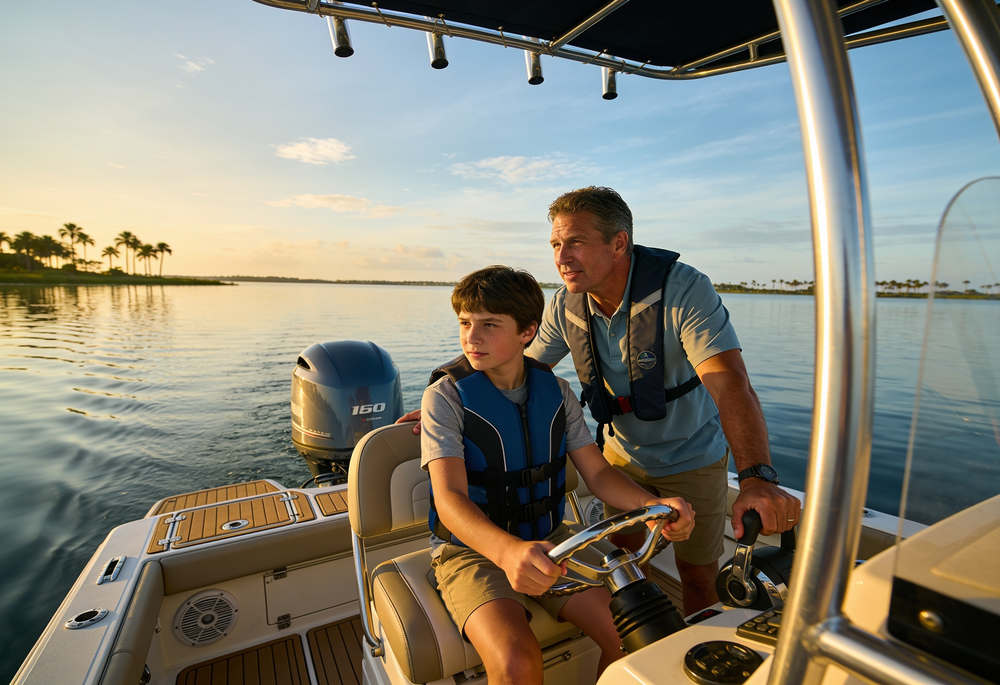
The fastest path to ruining your first season with a powerful new boat is skipping the learning curve and hoping experience comes quickly. It usually does not, and in a high-horsepower offshore center console, the consequences of an avoidable mistake on the water are significant. Florida has some of the best boating in the country, and new owners who approach the learning process seriously end up with years of great days on the water. Those who do not often have a shorter, more expensive relationship with the sport. Velocity Powerboats builds performance boats for serious boaters and takes the same approach to helping new owners get on the water correctly. Reach out to Velocity Powerboats for guidance on the right boat and getting started safely or call (877) 354-1159.
Start with a formal boating safety course, before anything else
New boaters launching from the Sanford area and throughout Central Florida sometimes assume that a boating safety course is for people who have never been on a boat at all. That is not the audience these courses are designed for. The USCG-approved courses cover the material that matters for anyone stepping up to a larger, more powerful boat: navigation rules, right-of-way situations on crowded waterways, reading buoys and charts, man-overboard protocols, weather pattern recognition, and the specific handling characteristics of high-powered vessels. None of that is obvious, and none of it becomes obvious through trial and error in a way that is safe for the people on the boat or for others on the water nearby.
The course should happen before the first real outing on a new high-horsepower boat, not after the first few trips build false confidence. A new owner who completed a USCG-approved course before taking delivery of his first performance center console on Lake Monroe described the experience this way: the classroom portion told him things he did not know he did not know, and that gap was larger than he had expected. He had been a passenger on fast boats many times. Being the person responsible for the decisions on the water was a different experience, and the course prepared him for it before the situation demanded it rather than after. That sequence, course first, boat second, is the right order regardless of how eager the delivery day feels.
Building real skills on the water
A boating safety course provides the knowledge foundation. The skills come from deliberate practice in conditions that match the learning stage. For a new owner on the St. Johns River waterway system and the coastal waters accessible from Central Florida, that means starting on calmer, protected water before running offshore, building familiarity with throttle response at lower speeds before pushing to higher ones, and practicing docking repeatedly in low-stakes situations before attempting it in wind or current.
Throttle control is where most new high-horsepower owners discover how different a performance boat is from what they expected. A triple- or quad-engine center console has a throttle response that is immediate and powerful in a way that smaller recreational boats are not. Acceleration that feels like a light suggestion at the helm translates to a dramatic change in speed and attitude within seconds. Learning that relationship in calm conditions, in open water with room to recover from mistakes, is how the skill develops. Learning it for the first time at the dock or in a tight channel is how incidents happen.
Trim management is the second skill that separates experienced performance boaters from new ones. The trim of the outboard engines, and on some boats the trim tabs, controls the running angle of the hull, which affects everything from fuel efficiency to handling to spray patterns to the feel of the ride in chop. A hull running at the wrong trim angle in rough water is working harder than it needs to and riding worse than it could. Learning to read the hull's attitude and adjust trim in real time takes time and practice, and it is worth seeking out someone with experience on similar equipment to run alongside on early trips.
Reading water and weather before you leave the dock
Florida's weather changes faster than almost any other boating environment in the country. Afternoon thunderstorms build quickly in the summer months, and a calm morning on the water can turn into a serious situation within an hour if the conditions shift and the boat is offshore without shelter. New owners who build the habit of checking the marine forecast before every trip, and who develop the habit of watching the western sky for building thunderheads during an outing, stay out of situations that experienced boaters avoid. A trip cut short by a developing storm is not a failed day. It is a correct decision made by someone who understood the environment they were operating in.
Matching the boat to the experience level
The right performance boat for a new owner is one that delivers real capability without demanding expert-level skills on day one. A powerboat configuration that balances performance with approachability lets a new owner develop skills at a pace that matches the learning curve without artificially limiting the experience. As confidence and skill develop, the center console boat platform opens up in ways that reward the time spent learning correctly. The buyers who enjoy their performance boats the most at year three are almost always the ones who took the first season seriously rather than treating the learning process as something to get through as fast as possible.
If you are a new or prospective Florida boater who wants guidance on the right entry point into performance boating and how to get on the water safely, Velocity Powerboats is a good place to start that conversation. Call (877) 354-1159 or contact Velocity Powerboats to talk through the right boat and the right approach for getting started on Florida's waters.