Ordering a Custom Offshore Performance Boat: How to Spec Your Build from Hull to Helm
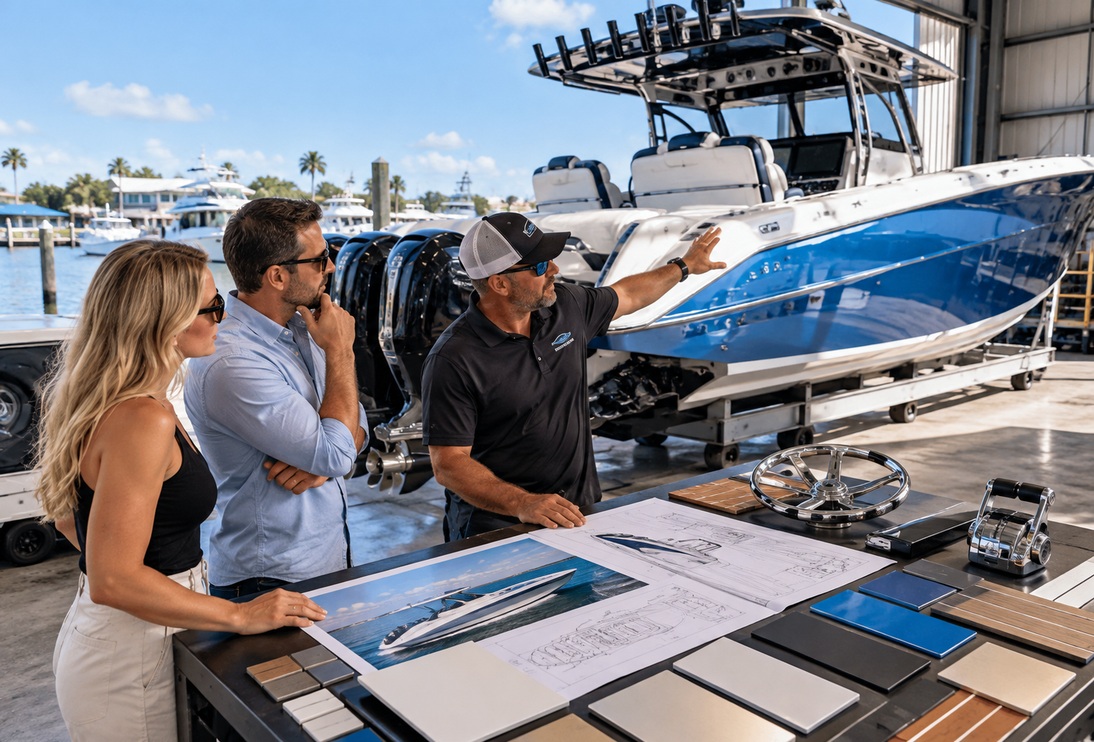
A custom offshore build is not a transaction. It is a conversation between what you want the boat to do and what the water around Sanford, Florida demands of it. Velocity Powerboats specs and builds performance boats for buyers who know what they want and need a builder who can execute it. Call us at (877) 354-1159 or reach out to our team to start that conversation.
How do you choose the right hull configuration for an offshore performance build?
Hull selection shapes everything downstream. A deep-V hull cuts through chop and holds a line at speed, which is why it dominates offshore racing and serious bluewater builds. The deadrise angle controls how aggressively the hull handles rough water: higher deadrise means a softer ride in chop but trades some flat-water stability. A stepped hull can recover that flat-water efficiency while still handling offshore conditions, depending on how the steps are positioned and vented.
Beam width, hull length, and running surface all factor into how the finished boat performs at speed. A build optimized for the St. Johns River and Lake Monroe is a different conversation than one headed to the Gulf Stream. Knowing your primary water is the first question we ask, because the hull that performs in your conditions is not necessarily the same one that wins on paper.
What engine package should you spec for a performance offshore boat?
Engine selection depends on hull size, target speed range, and whether you are running single, twin, or triple configurations. For a center console in the 26-foot range, twin outboards in the 300 to 350 horsepower class deliver the power-to-weight ratio that makes offshore running practical. Triple and quad setups on larger hulls push that range considerably higher and provide redundancy on extended runs where an engine-down situation has different stakes than it does inshore.
Electronic fuel injection, integrated digital throttle and shift, and joystick docking controls are standard expectations on a serious custom order now, not luxury add-ons. Speccing them correctly to work with your rigging, gauges, and helm electronics is part of what a quality builder does before a single component is bolted to the transom.
How do you design a deck layout that works for more than one kind of day on the water?
Deck layout is where the build gets personal, and it is also where conflicting priorities get resolved. We worked with a buyer who came in with a clear picture of what he wanted: a serious fishing platform with enough power to get to the fish fast and hold position in current. His wife had an equally clear picture, closer to a floating cocktail lounge than a tackle-storage system. Both priorities were legitimate, and neither one had to lose.
The solution was a custom deck spec with comfortable lounge seating in the cockpit, while routing dedicated storage for rods and tackle under the gunwales and in the console base where they were accessible without occupying the seats. The layout worked for a full day of fishing and converted to a clean social platform without gear across every surface. That kind of design thinking is what separates a custom build from a production boat with options checked off a list.
Our center console boats show the kind of deck real-ization that balance fishing utility and on-water comfort, and our powerboat builds demonstrate what a performance-first spec looks like when speed is the priority. Either gives you a starting point for your own conversation.
What upholstery and electronics choices matter most on a custom offshore build?
Marine upholstery on an offshore performance boat needs to handle UV exposure, salt spray, and the regular soaking that comes from running hard in chop. Solution-dyed acrylic fabrics and closed-cell foam cores hold up where standard marine vinyl eventually delaminates or fades. Color selection affects more than aesthetics: darker upholstery runs hotter in Florida sun, which matters on a boat that spends the day at a sandbar, while lighter tones show wear from sunscreen and wet gear faster.
On the electronics side, a custom offshore build warrants a properly integrated helm package: chartplotter, VHF with DSC, radar if the hull supports the arch, and a fishfinder sized to where you are actually fishing. Running a mismatched electronics stack on a quality hull is the equivalent of installing a budget stereo in a performance car. A builder worth commissioning will spec the helm to work as a system, not as a collection of units that happen to share a dash.
What are the typical build timelines and deposit structures for a custom order?
Custom builds at the performance level generally run four to eight months from signed order to delivery, depending on hull sourcing, engine availability, and the complexity of the custom elements. A straightforward build on an in-stock hull moves faster than a full custom with bespoke upholstery, specialty electronics, and a one-off paint scheme.
Deposits typically run thirty to fifty percent of the total build cost at signing, with a progress payment at hull completion and the balance at delivery. This structure keeps the build moving and protects both sides. The deposit conversation is also where you confirm the spec in writing, so there is no ambiguity later about what was agreed.
If you are ready to start speccing a build, call Velocity Powerboats at (877) 354-1159 or contact our team. Tell us what you want the boat to do and where you plan to run it.