Repower or Buy New? When Central Florida Owners Should Upgrade Their Offshore Boat
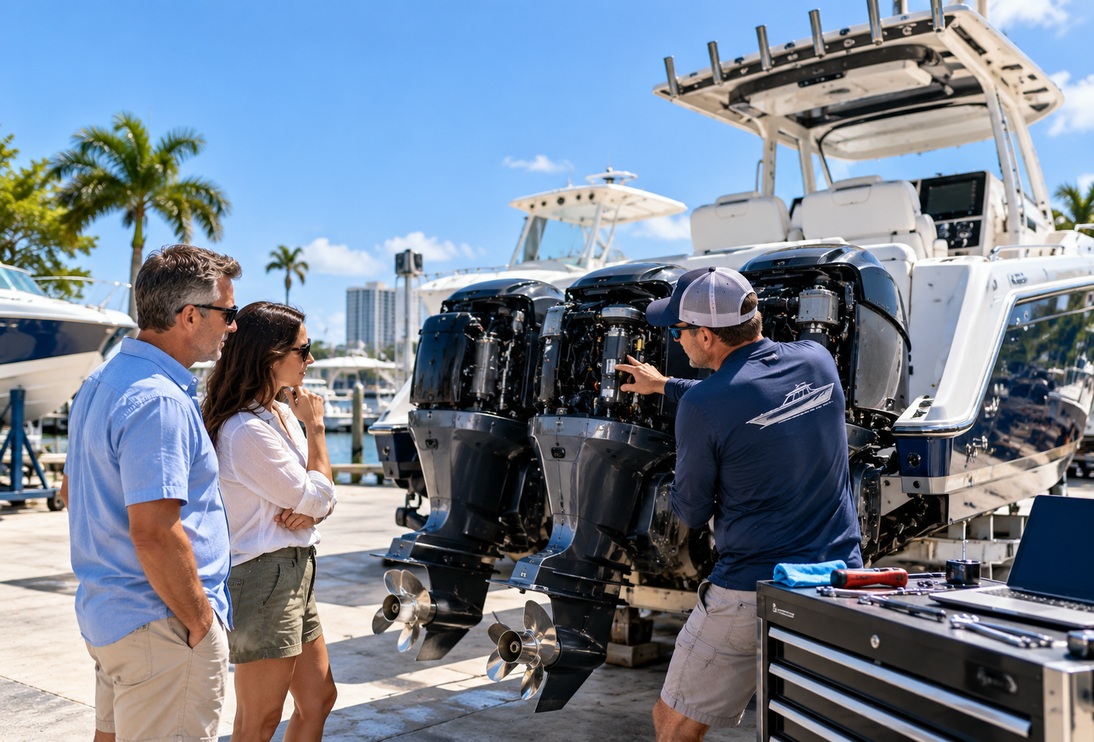
If your offshore boat is costing you more shop time than water time, you are already asking the right question. Velocity Powerboats works with Central Florida owners every season who are standing at exactly this crossroads, and the answer is not always the same. Call us at (877) 354-1159 or reach out to our team and we will help you run the numbers on both sides before you commit either way.
What are the signs your hull has outlived its drivetrain?
The clearest sign is a pattern, not a single repair. One engine issue in a season is bad luck. Two in the same season, or the same component failing twice, means the drivetrain is telling you something. When you are replacing impellers, injectors, or lower unit seals on a schedule that feels like a maintenance program, the engine is no longer a reliable tool. It is a liability.
Other signs are subtler. Corrosion on the engine block or rigging hardware that keeps coming back even after treatment suggests the motor has absorbed years of salt and heat that cannot be reversed. If the powerhead has already been rebuilt once, you are close to the ceiling on what that engine will give you. Fuel economy that has dropped noticeably from what the boat ran when new is another indicator worth taking seriously, particularly with today's fuel costs on longer runs out of Central Florida inlets.
The hull itself is a separate question. Gelcoat crazing, soft spots in the deck, or structural issues in the stringers are problems a repower does not fix. If the hull is sound, repowering makes more sense than walking away from a good platform. If the hull has issues of its own, you are potentially throwing engine money at a boat that still needs work on the other side of the repower.
How does the cost of a repower compare to buying a new boat?
A single outboard repower on a center console in the 23 to 26 foot range typically runs between $15,000 and $25,000 installed, depending on the horsepower class and whether you are also updating the rigging, controls, and gauges to match a modern engine package. Twin-engine repowers roughly double that. Those numbers look reasonable until you factor in that you are putting new-engine money into an aging hull, and the resale math changes significantly as a result.
A new hull in the same class comes with a manufacturer warranty, a drivetrain that has not accumulated heat cycles and salt exposure, and a hull designed around current outboard technology rather than one built for engines that no longer exist. The question is not just what the repower costs today. It is what the repowered boat is worth in three years versus what a new boat would be worth, and how much you plan to run it in the meantime.
When one Central Florida owner started calling his boat "The Dead Weight" after two engine repairs in a single season, he came to us unsure whether to repower or move on. We walked through the numbers together: his hull was sound, but the engine had already been partially rebuilt, and a full repower on a twelve-year-old platform would not recover its value at resale. He moved to a new build. He stopped calling his boat names.
How do newer hull designs improve ride quality and fuel efficiency?
Offshore hull design has moved considerably in the past decade, particularly for the size classes most Central Florida owners run. Modern stepped hull geometry reduces wetted surface at speed, which means better fuel efficiency and a flatter, drier ride in chop. Boats built for current four-stroke outboard technology have transom geometry, weight distribution, and running surface angles optimized for those engines in a way that older hulls designed around carbureted two-strokes simply are not.
The practical difference on the water is real. A current hull in the 22 to 26 foot class running twin mid-range four-strokes will reach cruising speed faster, burn less fuel to hold it, and handle the short-period chop you get on Atlantic-facing inlets differently than a hull from ten or fifteen years ago running equivalent horsepower. If you spend meaningful time offshore, that difference accumulates across a season into real hours and dollars.
What should Central Florida owners know about resale before deciding?
Resale value follows condition and age in that order, and a repower complicates the story. Buyers in the used market want to know engine hours and engine age. A boat with a freshly repowered motor on a twelve-year-old hull creates a mismatch that sophisticated buyers notice: they are buying a new engine on an aging platform, and they will price it accordingly. The repower adds value, but rarely equal to what it cost.
A new build depreciated normally over a few years often puts you in a cleaner resale position because the platform and the drivetrain age together. If you trade up every five to seven years, that math matters. Our powerboat builds and center console boats give you a concrete starting point for what a current hull in each class looks like rigged and ready, which makes the comparison against a repower estimate real rather than theoretical.
Call Velocity Powerboats at (877) 354-1159 or contact our team. Tell us what you are running and what it has been doing, and we will give you a straight answer on whether a repower makes sense or a new build is the better call.